
|
It is the bane of the classical martial arts community
that previously noble and exceedingly effective martial art forms have been reduced to posing and posturizing with "sounds of fury, signifying nothing."  — Bruce Frantzis — Bruce Frantzis
|
|
Youth is like spring, an over-praised season
more remarkable for biting winds than genial breezes.
Autumn is the mellower season, and what we lose in flowers we more than gain in fruits. — Samuel Butler
|
|
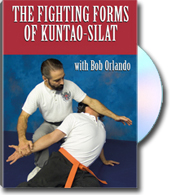
Shortly after producing our The Fighting Forms of Kuntao-Silat video, a friend – an experienced and highly skilled martial artist – asked, "Your previous material covered mainly concepts and drills of Kuntao-Silat. Why did you decide to bring out a forms video when many people nowadays feel forms are not the best tool to learn fighting applications?"Great Question! My friend was right. Forms training really is underappreciated. Television today is full of mixed martial artists whose training focuses for the most part, on strength, takedowns, submission holds and sparring, and all that within a framework of specific safety rules.1 |
|
|
Forms training is far from the mind of most of such young, strong competitors dreaming of fame and glory. Interestingly, that is a lot like I felt in my earlier years of training. No wonder my friend asked why I would come out with a forms video when the martial arts world is so focused on other things. How did I, in fact, move from one who really did not appreciate forms, to the place now where I would never even consider eliminating them from our training curriculum? As I considered my own change in forms appreciation, I realized that forms practice actually gave me specific practical skills which I could put to use in the other aspects of my martial arts training, practice, and even in everyday life. Forms study also opened my eyes to strategic thinking, learning to flow naturally from defense to offense, stance to stance, and foe to foe. Through the years of practice I found that I also gained the invaluable perspective of time, learning from experience that life-long martial artists invariably undergo changes in their own strength and physical capabilities, and that forms-study and training can actually help them adapt and even improve their effectiveness despite the challenges of aging. Finally, I recognized that forms are actually a significant contributor to having a truly complete system of training, and are an essential complement to drills, physical conditioning, bag work, and a host of other training methods. In what follows, I will attempt to explain each of those points in the hope that in the end, you too, will have a greater appreciation of the value of forms training. Let us begin. Practical Skills from Forms Training |
|
Simply put, forms study and training teach you primarily two things: One mental, one physical.
Remember the movie Braveheart? In the scene where the Scottish farmers perform their own traditional
burial service for William's father and brother, young William takes the sword from his uncle Argyle
(played by Brian Cox) and tries to lift it. His uncle slowly and gently takes the sword back and
then says to young William,
First, learn to use this ...Forms training teaches us just that – to use our minds, before and then, along with our bodies. Mentally, forms training teaches strategic thinking. Physically, it is simply, how to move. We will look at the "how," the physical side, in a moment, but first, let us examine the mental side, the strategic thinking. |
|
Strategic Thinking
As hand drills train the hands, so leg drills train the legs. Techniques, in turn, integrate the previously trained limbs into a coordinated defense. All of that can be accurately described as fighting tactics. By "tactics," we mean that for the most part, the student is practicing a technique – either with a training partner or solo – with a focus on the immediate "battle" before him. Tactics are the "how" to implementing battle strategy. Like the squad leader in the field, the defender's focus is rightly limited to the methods needed to overcome the adversary immediately before him. Training drills and techniques are really only suited to equip the martial artist to effectively fire using his arms and legs, and that only toward the threat before him. Little thought at that level is given to protecting his flank or preparing for other potential threats. As the squad leader moves up to platoon leader or company commander, his vision must expand to see beyond the immediate threat before him. His thinking must broaden from the narrower-focused battle tactics to the broader campaign or battle strategy.
|
| Strategic training goes beyond techniques or tactics, assuming, among other things, a longer running conflict with multiple assailants. Combat on such a field requires more than just trained arms and legs, more than just tactically coordinated techniques designed to defend against a single anticipated assault and lasting only seconds. Combat in that field requires total body and mind integration and coordination – something that has been thought out and worked through frequently in a variety of ways long before you get into such a fight. When the serious fight breaks out and your body is slammed with adrenaline, that is not the time to think about strategy. Training time is the time to so think, and forms training is well designed to meet that critical need. |
|
|
I said before that the physical skill taught by forms is simply, "how to move." That is, how to move from man to man, assailant to assailant, transitioning smoothly through various assaults in a variety of ways, all without tripping over your own or someone else's feet. With a reasonable number of good forms then, one can easily imagine how many different defenses are presented for say, kicking attacks: kicks coming at you from your left, your right, in front, at varying angles, and to different targets (groin, body, legs, etcetera). Sure, the attacks are choreographed,2 but the order of the various attacks is really unimportant! What is important is training your ability to move from man to man, actually flowing like water from one defense to another, effectively using the variety of stances available to you along with all the other tactical skills acquired through your training. What other training tool provides that? Or, perhaps, a better question is, "Do you even see a need for such training, and if so, how do you meet that need?" For us, forms training more than adequately meets that critical requirement. Let me share just one real life example of the success of that kind of training. |

|
The Country Buffet "Good forms" have already been mentioned, but for forms training to be truly effective, two more things are equally critical: time and good teachers. Good teachers should be obvious, but such teachers can be hard to find. My friend, Michael Smith, accurately described "good teachers" like this. Such teachers must retain the belief that there is value in preserving something in the way that it was taught to you in order for future generations to think about, ponder and glean from it what they can. Just, because I think something is useless doesn't mean someone else in the future (or perhaps myself in future years when I am hopefully wiser) can not make some great advancements in martial arts from studying the material.Frankly, it is tough to find teachers with that kind of humble insight. The Perspective of Time "Youth is like spring, an over-praised season more remarkable for biting winds than genial breezes. Autumn is the mellower season, and what we lose in flowers we more than gain in fruits." In the last decade I have really begun to see the value of forms training. Is it because I am older and weaker? Without a doubt, I am older, and though I regularly and vigorously workout at the gymnasium, I also recognize that I am not as strong as I was thirty years ago. But do you know what? I actually strike faster and hit harder now than I did thirty years ago. And I move far, far more efficiently than I did back then as well. I am older now and not as strong as I once was, but that is not why I appreciate forms more now! Although age is not directly the key to appreciation, it is still so indirectly. For some of us, forms appreciation only comes with time (which in many cases means "as we get older") and such a journey may look like we come appreciate forms simply because we can do nothing else. But that is simply not so! Allow me to share just three of the many natural parallels in life that show the difference time makes in appreciating many things. We have already shared Samuel Butler's great quote, but consider my friend, Michael Smith's thought. He says, "Forms are kind of like songs: You may not really like or appreciate them all that much at first, but they can grow on you with time." Another equally natural parallel in life comes from cooking. Ingredients are absolutely critical to cooking anything, no question, but so is time. Cook something that requires an 50 minutes 325 degrees. Instead, cook it for only 20 minutes – even at 500 degrees – and you will very likely NOT appreciate the result. Again, appreciation and value assumes that you first have good forms (music or ingredients) to begin with and good teachers (singers, musicians, and cooks) with which you can study. But here is my favorite example of how time naturally changes perspectives and subsequent appreciation of anything. Consider boys and girls.
|
| At seven years of age, a little boy looks at a little girl like, "OK, she's not like my buddy, but she might do anyway." But ten years later? WOW! Does the young man's appreciation for the young woman go through the roof! But even then, such appreciation is largely a short-lived, tongue-hanging-out-of-the-mouth desire. In truth, it really takes a man being wed thirty or more years to the same woman to really come to appreciate her – an appreciation that goes well beyond the physical. Forms study and appreciation, in fact, parallels that – we simply have to see them over time (years sometimes) to truly appreciate their value. |
|
|
The Strongest Challenge
Another issue needs to be addressed here, one that ties directly to the age of the practitioner. This issue, naturally coupled with youth, actually raises a significant challenge to forms study and training. That issue is talent. That's right, gifted, natural talent – talent the individual possessed before he ever started training. Does anyone really believe Bruce Lee 3 was as good as he was based solely on his training? Of course not. He was a very gifted and highly talented young man whose training actually focused and amplified his own almost supernatural talent. Unless properly introduced to forms training (from a good teacher exploring good forms), then the younger,4 gifted and naturally talented students – those who are either stronger, larger, or faster than most of us – those talented individuals may never come to fully appreciate forms training precisely because of their talent. How come? Because their training will only be focused on those things that build on their natural talent. Further, youth blocks vision precisely because it lacks experience! How many newly wed young men are prepared for marriage and all the marital issues that involves? Unless the young man had great parents from whom he learned a lot about marriage, by their example and counsel, he is unprepared! That same truth looms over martial arts training (and all of life for that matter) just as strongly. Add to that the gift of natural physical talent and the equally natural focus that trains according to that strength, and now you have a serious challenge to any appreciation of forms training. The problem with talent is that one often says, "I don't need forms training. I'm strong enough" or "I am big enough" or "I am fast enough that I don't need anything else." It is precisely this combination of lack of experience and natural talent that provides the strongest challenge to forms study. As we say in our "Training Smarter" article, aging and injury can actually be your friends. As much as they hurt, they at least force us to look at other training tools and methods that we might not seriously consider otherwise. Oh how I would have loved to have been so physically talented. But alas, I am not. Worse, I have experienced physical maladies coupled with the natural aging process that have made the study of martial arts difficult. But all that falls under the "Experience" heading and it is precisely that experience that forced me to look into all areas of martial arts to develop ever-improving skills. I have a friend who is incredibly strong and weighs over 300 pounds. He often says things like, "In that situation I would just grab him and do ... [whatever]". His strength and size are precisely why he has trouble seeing the value in so many of the other things we do! Many who do not appreciate forms training are, relatively speaking, young, strong, and/or talented. Seeing the benefits of forms study and training are hard, at best, for such individuals to even recognize, much less appreciate. Those of us lacking our once youthful strength and/or natural physical talent, can no longer totally rely on those gifts to defend ourselves. So we open our eyes and look at anything that might contribute to the continuing development of our martial skills. For those of us so blest, that includes forms training. |
|
A Complete System |
||
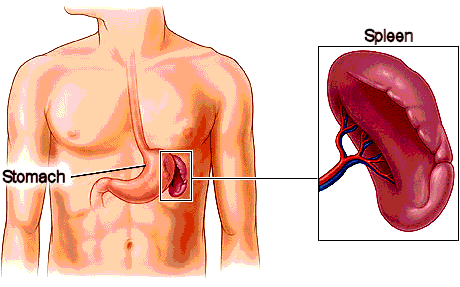
| Lastly, forms training should be seen as part of a complete martial art system. Think of it like this: Just as the human body has certain organs that we can live without – there are other critical organs we really cannot live without and lead normal lives. For example, while the body can survive the absence of the spleen, one really does not want to do that unless absolutely necessary because no spleen means that the individual suffers with an extremely poor and highly |
|
|
|
vulnerable immune system – a system so weak that a common cold can result in death. A similar case can be made with regard to cutting out forms training from the whole body of martial arts instruction. |
||

|
We briefly touched on this before, but all the preceding arguments are totally dependent on two things: 1) Good, content-rich forms, and 2) Good teachers – teachers who do more than just fill the student's training time with solo practice. Regarding the forms themselves: Unfortunately, the critics are correct, bad forms suck; they truly deserve all the bad press they receive. But all too often, instead of seeking good forms from good teachers, critics simply throw the baby out with the bath water. That is really sad. Perhaps, as time marches on and their youth, natural strength and speed diminish, and they are fortunate enough to observe an "interesting" form, they just might reevaluate their view of "good forms" training and diligently seek such from a good teacher. Which brings us once again to "good teachers." | |||
|
Good teachers seek, explore, and study forms they have found to be "good," breaking down every movement and technique for themselves and their students so that all see and practice their forms with understanding. From such a teacher,5 the student should come to see every movement and technique in a form as placing him in the middle of the given movement's or technique's possibilities. From there, applications can be developed fully with various training partners – tall, short, heavy, ugly, whatever – adjusting every move to make it fit both the student, his partner, and the envisioned fight scenario. Doing so is the only way forms training can ever become the significant martial skill development tool it was intended to be. Conclusion
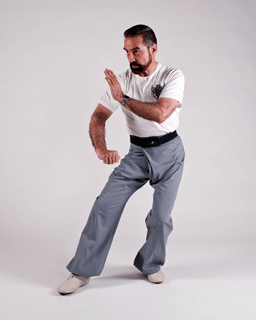
One may eliminate forms study and training from the curriculum (indeed, many already have), but it is really unwise to blindly do so. It is unwise not only for the reasons already cited, but also because doing so actually weakens the individual's overall defense capabilities! Taken together with drill training, technique study, bag work, weapons training and others, forms training remains a significant contributor to the development of effective fighting skills. Eliminating good forms training 6 from one's curriculum only makes the practitioner's knowledge and skill incomplete. If you train for self-defense, do you really want to pass on anything that might make you a more formidable foe? I know I don't.  When we decided to put together our Fighting Forms of Kuntao-Silat video, frankly we never gave the fact that it was about forms a second thought. For us, forms training was a highly valued and most appreciated training tool. But since my friend's great question, I now fully understand and can actually explain why we so appreciate them. The following slide-show provides just one example of how movements and associated techniques presented in forms can be studied, broken down, and otherwise understood in a manner that makes learning them both profitable and enjoyable.
|
||||
|
|
JavaScript slide show freely provided by
Javascript Kit. Photos used therein provided by Shawn Kassner, owner and operator of Maroon Creek Photography. |

|


|
©Copyright Bob Orlando, 2009-2016 All rights reserved. |
http://www.OrlandoKuntao.com
E-mail: Ron@OrlandoKuntao.com |
Last update:
Aug. 6, 2016 by Bob Orlando |
| Web Site of Bob Orlando: Instructor in Kuntao-Silat (Chinese kuntao and Dutch-Indonesian pukulan pentjak silat), author of two popular martial art books: "Indonesian Fighting Fundamentals" and "Martial Arts America: A Western Approach to Eastern Arts"; and producer of four martial art videos: Fighting Arts of Indonesia, Reflex Action, Fighting Footwork of Kuntao and Silat, Fighting Forms of Kuntao-Silat. Offering practical martial arts instruction to adults living in and throughout the Denver metropolitan area including, Lakewood, Littleton, Morrison, and Golden Colorado. |